
To accuretly calculate your project cost you will need to go through 3 steps which are:
- Define Scopes - collect Drawing,Geotechnical Reports,Groundwork Elements and Site Challanges
- Calculate Quantity - how much material you will need for the job (Volume, Area, Length, Count)
- Add Labour and Equipment Costs - Include labour for each step and equipment needed
We will go through a real world example on how to do it so that you can learn exactly the best way to estimate costs :
1. Define Scope
We will be building a subdrain also known as a French Drain for this example, and the first steps are to define the scopes of what we are actually doing.
The business asking us wanted to add a drainage along the car park for their new build and we need to look at the drawing and soil to get a good idea of what we are working with:
- The drainage length needs to be 8 Meters long
- The trench is 50cm deep
- The soil is regular and sound
- We will need 8 meter perforated drainage pipe
- Gravel with large chunks
- Foil (geotextile fabric) for the sides of the drain
- No top soil - they want exposed stones for faster drainage
Additional scope considerations (always document these):
Trench width is typically 30-45cm. We will assume 40cm wide unless the drawing says otherwise. The pipe should have a minimum slope for proper flow. Check where the water will discharge. Note any site challenges such as access, nearby utilities, or traffic in the car park. Since the soil is sound, minimal extra support is needed but always verify on site.
This step prevents scope creep and ensures you do not miss hidden costs.
2. Calculate Quantities
Now that the scope is clear, work out exactly what materials are required. Use the trench dimensions: length 8m, depth 0.5m, width 0.4m.
Trench volume is 8 × 0.4 × 0.5 = 1.6 cubic metres.
Materials breakdown:
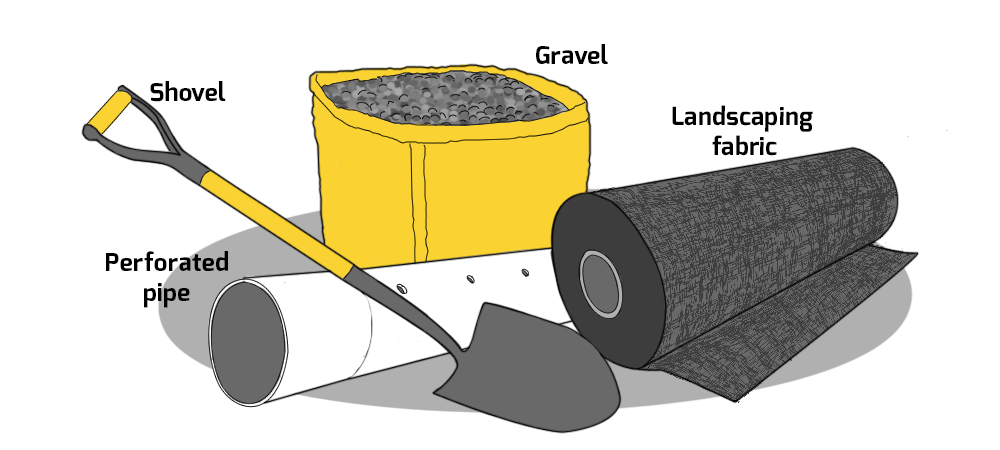
- Perforated Drainage Pipe: 8 metres plus 10-20% extra for fittings and waste. Typical size is 100mm.
- Geotextile Fabric: Covers the bottom and both sides. Roughly 12-15 square metres including overlaps.
- Gravel: 1.2-1.4 cubic metres of large chunky clean stone (around 2-2.5 tonnes). This fills around the pipe with the top left exposed.
- Other items: End caps, couplers, and any outlet fittings.
Always add 10-15% contingency for waste or minor changes on site.
3. Add Labour and Equipment Costs
With quantities known, price everything out using current local rates.
For this 8 metre job in the UK:
Labour for excavation, pipe laying, and backfill will likely take 1-2 days for a small crew. Equipment may include hand tools or a mini-excavator rental plus delivery of materials and removal of spoil.
Sample cost breakdown for the 8m French Drain (in GBP):
Materials for pipe around £20-£50. Geotextile fabric £15-£35. Gravel £60-£120. Labour for the crew £300-£700. Equipment rental and transport £100-£250. Miscellaneous items £50-£150.
Total estimated cost for this simple job would typically fall between £550 and £1,400. This works out at roughly £70-£175 per linear metre depending on exact conditions. Professional installation rates often range from £50 to £150+ per metre in the UK, varying with depth, access, and location.

Final Tips for Accurate Estimating
Cross-check everything against the drawings and carry out a site visit. Build in a profit margin of 15-30% plus 10-20% contingency. Get multiple quotes from suppliers. Document all your assumptions so you can adjust the price if conditions change on site.
By following these three steps - Define Scope, Calculate Quantities, then Add Labour and Equipment Costs, you will produce reliable estimates that protect your margins and keep clients happy or if you are doing it for yourself you will know how much the job will cost.
Practise on small jobs like this 8m French drain and you will quickly improve.
Ready to grow your B2B business?
Join thousands of UK businesses buying and selling on Webwicked — no upfront costs.
Get Started Free